
Hero Match Puzzle Quest
Review
Hero Match Puzzle Quest ties puzzle performance directly to combat power, creating a risk-reward loop that rewards planning over reflexes. The turn-based pacing and browser-based access make it easy to share across ages seven and up. The main limitation is the lack of stated multiplayer or offline play, and the exact number of levels is unspecified. Best for casual players who enjoy match puzzles with a tactical twist.
Full story
Matching as a Combat Resource
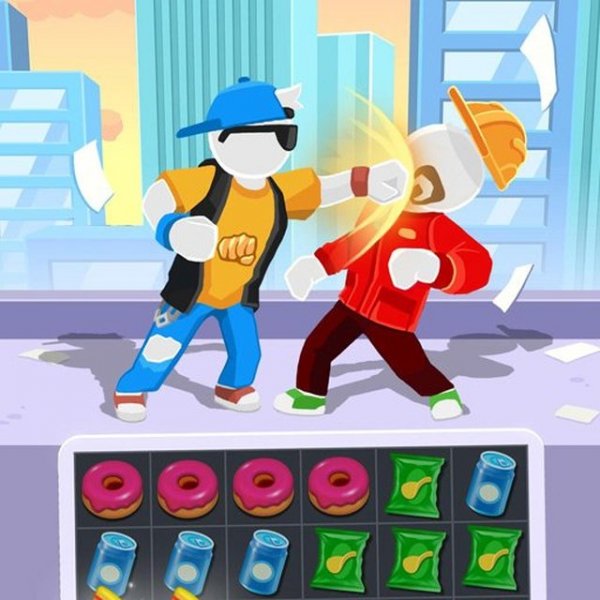
Hero Match Puzzle Quest is built around a grid of food and drink items. Players draw a continuous line through matching items; the length of that line determines how much energy the hero gains. That energy is not a score—it directly powers the hero's actions in the turn-based phase that follows. A short chain yields a modest move, while a long chain can produce a decisive opening strike. The puzzle and the battle are inseparable: every match decision shapes the encounter.
Turn Order and Encounter Flow
After the matching phase, the hero and the opponent exchange actions in turns. The hero's first action is determined by the chain built during matching, so a strong opening can set the pace and finish a fight quickly. The opponent responds according to its own energy, which the player must reduce to zero before the hero's energy runs out. Because turns are discrete, players can think through each move without time pressure. This structure rewards planning over reflexes, though quick recognition of grid patterns still helps.
Controls and Accessibility
The game uses mouse or touch input and runs in modern browsers. A full-screen mode is available for a more focused view of the grid and the battle interface. The target age is seven and up, and the design avoids complex menus or hidden systems. New players can begin by matching obvious pairs, while experienced puzzle fans can hunt for longer chains and more efficient turn sequences. The difficulty comes from reading the grid and managing the hero's energy across multiple opponents.
Progression and Audience
Players advance through a series of levels, each introducing a new opponent. The input does not specify how many levels or opponents exist, but the structure implies a steady escalation as players learn to build longer chains and time their actions. The family-friendly theme and simple controls make it suitable for younger players and casual sessions, while the turn-based format offers enough strategic depth for adults who enjoy match puzzles. There is no stated multiplayer mode, so the experience is a single-player progression against computer-controlled foes.
Compatibility
FAQ
Reader Comments
Sign in to comment
You must be logged in before posting a review or rating.
No comments yet. Be the first to comment!



Editorial Notes